
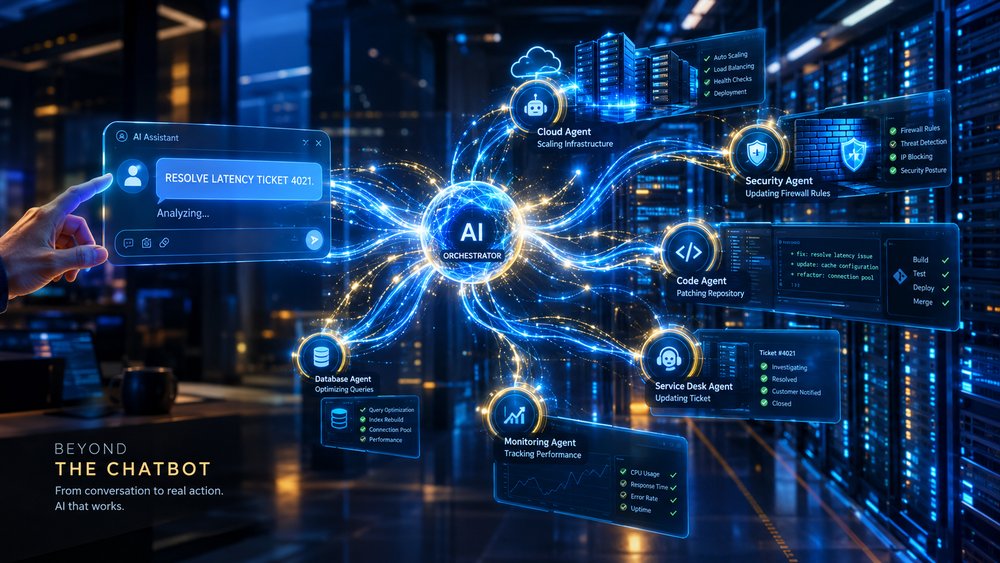
Beyond the Chatbot: How Agentic AI and Autonomous Workflows Are Redefining the IT Enterprise
For the past few years, Artificial Intelligence in the enterprise was defined by the conversational interface. We queried large language models (LLMs) to write copy, draft code snippets, or summarize documents. While useful, these implementations were largely reactive, relying entirely on continuous human prompt engineering and step-by-step supervision.
We are now witnessing a fundamental shift away from simple text-generation interfaces toward Agentic AI—systems capable of autonomous reasoning, multi-step planning, tool utilization, and execution. Rather than acting as a digital sounding board, AI is transitioning into a proactive operational layer across enterprise IT ecosystems.
What Is Agentic AI?
Unlike standard Generative AI, which produces output directly following an input prompt, an AI Agent is designed to accomplish complex goals autonomously. Given an instruction like "Resolve ticket #4021 regarding database latency," an agentic system does not simply output instructions for a DevOps engineer.
Instead, an agentic framework breaks down and executes the workflow:
- Analyzes Context: Parses log files and retrieves real-time telemetry data.
- Plans Actions: Formulates a sequential diagnostic strategy.
- Calls Tools & APIs: Queries monitoring dashboards, runs benchmark scripts, or scales infrastructure instances directly.
- Iterates & Adapts: Evaluates the output of each tool call and adjusts its execution plan if initial fixes fail.
- Requests Approval (Human-in-the-Loop): Escalates to human engineers only when hitting defined governance thresholds or security boundaries.
Key Pillars Driving the Agentic Shift
1. Multi-Agent Systems (MAS)
Single LLMs often struggle with broad, multi-faceted tasks due to context limits or hallucinations. Enterprise architectures are turning to specialized Multi-Agent Systems where specialized agents collaborate:
- Developer Agent: Writes unit tests and underlying code.
- Security Agent: Scans code against open-source vulnerability databases.
- Deployment Agent: Manages CI/CD pipelines and infrastructure configuration.
2. Dynamic Tool Calling & API Integration
Agents are empowered through function calling and API access. They can read and write across databases, interact with SaaS products like ServiceNow or Jira, execute code in sandboxed environments, and trigger external cloud workflows without human manual intervention.
3. Shift to Hybrid, AI-Ready Infrastructure
Running autonomous, high-throughput agent workflows creates massive demand for low-latency inference. Enterprise IT is shifting away from purely cloud-centric LLM API calls toward hybrid architectures: lightweight local SLMs (Small Language Models) handling edge or real-time tasks, with large foundation models reserved for heavy reasoning workflows.
Enterprise Use Cases Transforming IT Operations
- Autonomous DevOps & CI/CD: Agents monitor build failures, automatically construct patch pull requests, run regression testing, and present verified fixes to engineering leads.
- Self-Healing Cyber Infrastructure: Beyond passive threat monitoring, agentic security engines analyze vector threats in real time, isolate compromised containers, and adjust zero-trust firewall configurations to limit blast radius.
- Automated IT Service Management (ITSM): Basic tier-1 and tier-2 service desk queries—such as access provisioning, software installs, or VPN configuration—are handled end-to-end without human intervention.
Key Challenges to Overcome
While the potential is clear, moving from pilots to production-scale agentic deployments presents unique operational hurdles:
| Challenge | Real-World Impact | Solution Strategy |
|---|---|---|
| Cascading Failures | An error by one agent in a workflow can compound across connected tools. | Strict error-handling protocols, logging, and rollback mechanisms. |
| Agent Drift & Hallucination | Autonomous agents taking actions based on incorrect reasoning paths. | Human-in-the-loop (HITL) checkpoints for destructive or high-cost actions. |
| Security & Authorization | Agents exploiting system privileges or leaking data across APIs. | Least-privilege API design, granular scoped permissions, and active logging. |
| Uncapped Cost Spikes | Multi-agent recursive loops consuming unexpected amounts of compute/tokens. | Deterministic loop limits, token limits per execution run, and SLM offloading. |
The Path Ahead
The value of AI is no longer judged by how well it answers a question, but by how effectively it completes a process. For IT leaders, the priority is shifting from "How do we give employees an AI assistant?" to "How do we redesign business processes to support human-agent teams?"
Organizations that build robust governance models, modular architectures, and structured API layers today will lead the shift toward fully autonomous, highly efficient IT operations.